3 Problems Your Customers Can Solve with Follow Stream
Every digital service depends on the health of the conversations happening across the network. APIs exchange credentials, web servers deliver content, clients negotiate secure channels, and microservices pass requests back and forth. When one of those conversations breaks, performance drops, workflows stall, and end users feel the pain immediately.
The way to dive into the actual output of these conversations is to follow a given transport stream via Wireshark’s “Follow Stream” capability. It reconstructs what happened at the application layer so they can solve problems that dashboards, metrics, and logs can’t explain.
Our latest Packet Viewer release makes Follow Stream even more useful through a new standalone view and significant performance improvements. Adding this feature directly into your product gives your customers a major tool for solving their problems. Here are three problems where Follow Stream creates the biggest impact.
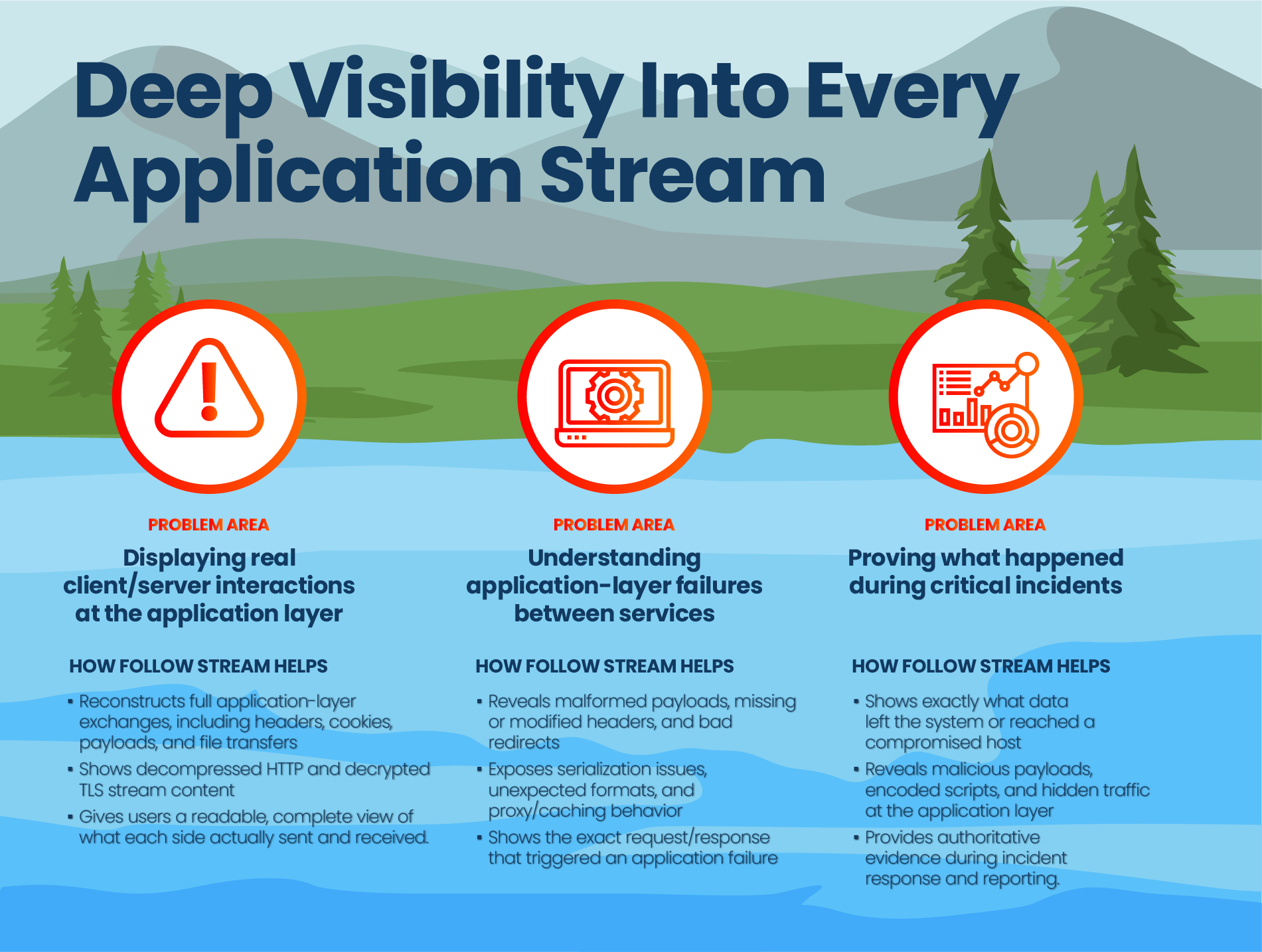
1. Displaying real client/server interactions at the application layer
Most debugging starts with a straightforward question: What did the client actually send, and what did the server actually respond with? Logs summarize behavior, dashboards infer behavior, but only the application-layer exchange shows what was sent on the wire.
Follow Stream reconstructs the full contents of these conversations so your customers see every detail the application processed. They can see HTTP headers, cookies, redirects, JSON bodies, file transfers, and any other data the service exchanged. When compression or TLS encryption hides the underlying content, Follow Stream reveals it uncompressed and, when TLS keys are provided, fully decrypted.
This gives users a complete, readable transcript of both sides of the interaction. They see exactly what was sent to the application, making analysis faster and far more accurate.
2. Understanding application-layer failures between services
Distributed systems can fail even when the network works perfectly. How often do we shout “it’s not the network!” These failures often stem from the contents of an exchange rather than transport-layer behavior. A missing header, an unexpected JSON field, an incorrectly rewritten URI, or a subtle serialization mismatch can break an entire workflow.
Follow Stream exposes these issues by showing the exact application-layer data that triggered them. Users see malformed or incomplete payloads. They spot missing, modified, or proxy-injected headers. They identify bad redirects, incorrect caching behavior, or data transformations performed by gateways or load balancers. And because the tool presents the entire request/response pair, they can see the precise point at which the service returned an error, rejection, or failure.
3. Proving what happened during critical incidents
When teams investigate outages, suspected breaches, or critical customer complaints, they need a source of truth. Metrics show trends. Logs show summaries. But only a reconstructed stream shows the authoritative record of what actually occurred.
Follow Stream gives your customers that evidence. They verify whether sensitive data crossed a boundary. They confirm whether a client followed protocol or whether a third-party service responded in a non-compliant way. They validate that an API returned an error the application didn’t handle, or that a service unexpectedly changed its payload structure
This level of fidelity matters when teams escalate issues, respond to regulators, or communicate with high-value customers who demand proof. Follow Stream turns speculation into clarity and gives teams confidence to resolve disputes with evidence instead of theories.
Why this matters inside your product
Your users don’t want to export files, open external tools, or juggle workflows. They want insight right where they work. By embedding Follow Stream, you give them the ability to drill into the truth of any problem without switching contexts. You enable better troubleshooting, stronger evidence gathering, and faster resolution of customer-impacting issues.
When your customers understand the real conversation, they fix issues faster, and their own users experience fewer unexplained failures. Learn how by requesting a demo of Packet Viewer.
